Why Composite Technology Is Changing Grinding Mill Wear Performance
Grinding roller sleeves are core wear components in coal mills and vertical mills. Their performance directly affects mill stability, maintenance frequency, and overall operating cost.
Traditionally, roller sleeves are manufactured either by hardfacing welding or whole casting with high-chromium iron. While widely used, both methods have clear limitations in service life and reliability.
In recent years, metal-ceramic composite roller sleeves have emerged as a more robust alternative, especially for power plants and cement mills operating under high load and long campaigns.
This article compares the two solutions from a practical, operational perspective.
1. Traditional Roller Sleeves: Proven, but Limited
1.1 Hardfaced Roller Sleeves
Process
A wear-resistant alloy layer is welded onto a low-carbon or low-alloy steel base.
Advantages
- Lower initial manufacturing cost
- Easy to repair by re-hardfacing
Limitations
- Wear layer thickness is usually limited to ~20 mm
- Requires frequent shutdowns for re-hardfacing
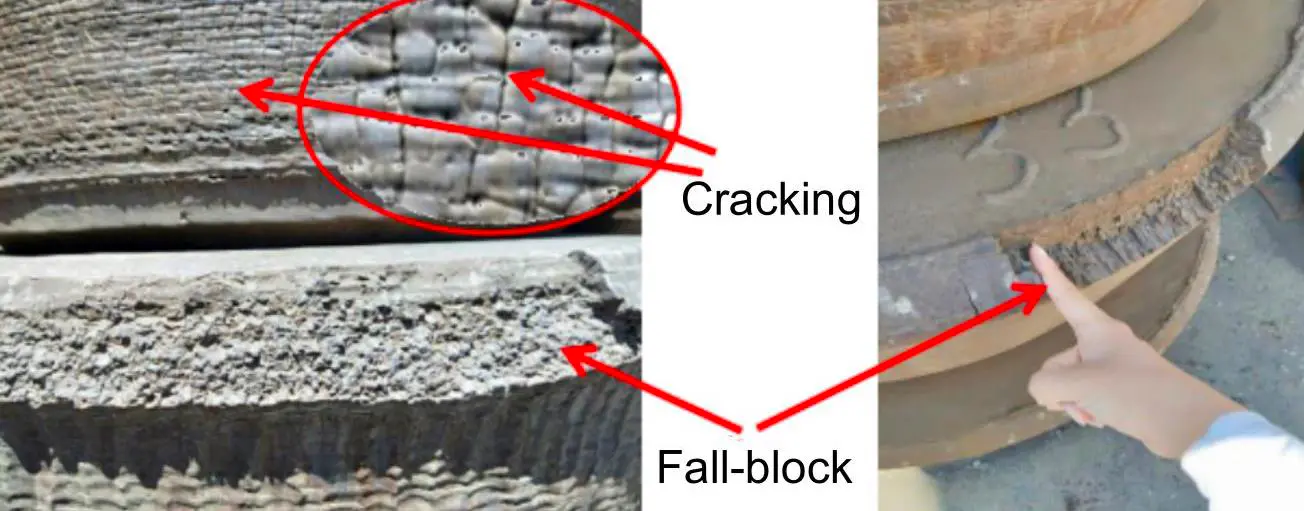
- Repeated thermal cycles and mill vibration often lead to:
- Stress concentration
- Cracks in the hardfaced layer
- Risk of sleeve fracture over time
In practice, maintenance intervals become shorter and less predictable as the sleeve ages.
1.2 Whole-Cast High-Chromium Roller Sleeves
Process
The entire roller sleeve is cast using high-chromium white cast iron.
Advantages
- Higher initial wear resistance than hardfacing
- No welded interface
Limitations
- Typical service life in power plant coal mills: ~8,000 hours
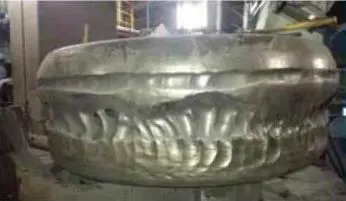
- Alternating operating temperatures cause:
- Residual austenite transformation
- Microstructural stress accumulation
- Increased cracking risk
Once cracks initiate, failure can propagate quickly, posing safety and downtime risks.
2. Metal-Ceramic Composite Roller Sleeves: Designed for Long-Term Stability
To overcome the inherent limits of traditional methods, TSR developed metal-ceramic composite roller sleeves using advanced overseas technology.
2.1 Composite Concept: Hard Where It Wears, Tough Where It Matters
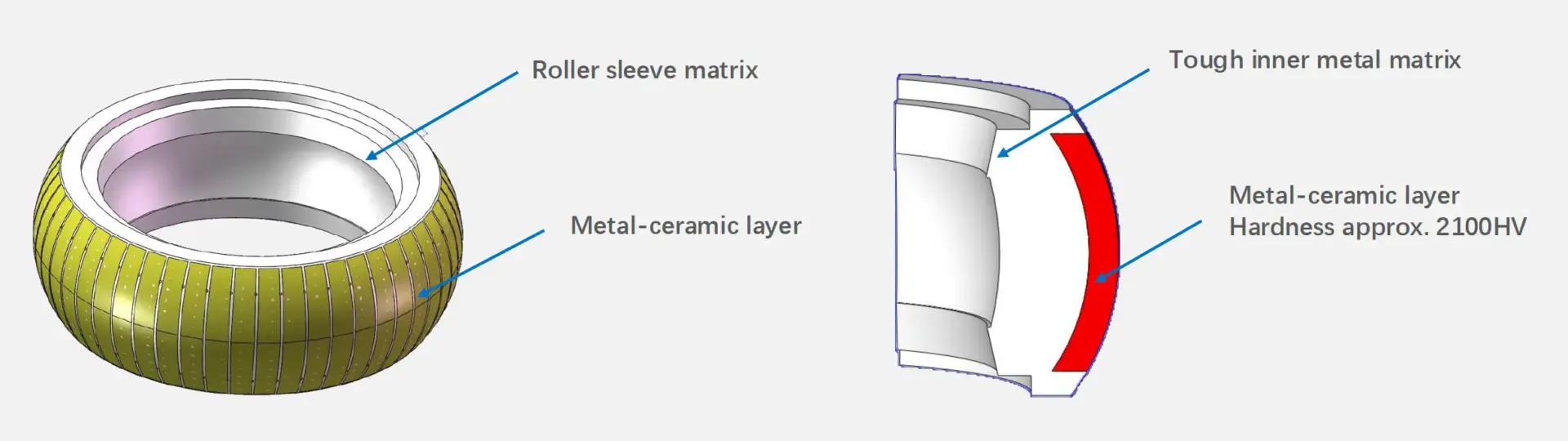
The roller sleeve adopts a “metal-ceramic wear layer + tough inner metal matrix” structure:
- Outer metal-ceramic layer
- Ceramic hardness: ~2100 HV
- Excellent abrasion resistance
- Inner tough metal matrix
- High tensile strength (>500 MPa)
- Elongation >12%
- Strong resistance to impact and thermal stress
This design ensures both wear resistance and structural safety.
2.2 Key Manufacturing Features
- Honeycomb ceramic preform
- Increases effective grinding area
- Improves surface friction and grinding efficiency
- Surface-alloyed ceramic particles
- Strong metallurgical bonding with high-chromium iron
- Prevents ceramic detachment under vibration or impact
- Centrifugal composite casting
- Ensures uniform material distribution
- Enhances operational stability
- Reduces mill power consumption
- Controlled heat treatment
- Outer layer hardness: >HRC 62
- Inner layer maintains toughness and crack resistance
3. Performance Comparison at a Glance
| Aspect | Traditional Roller Sleeves | Metal-Ceramic Roller Sleeves |
| Wear resistance | Limited by hardfacing thickness or material fatigue | >3× wear resistance under same conditions |
| Crack risk | Medium to high over long campaigns | Significantly reduced |
| Maintenance frequency | Frequent re-hardfacing or replacement | Extended replacement interval |
| Operating stability | Declines as wear progresses | More stable over full service life |
| Suitability for low-grade coal | Limited | Excellent, even for gangue-containing coal |
4. Field Application: Proven in Long-Term Operation
In a 600 MW power plant, TSR metal-ceramic roller sleeves were installed in a ZGM123N coal mill:
- Wear after 4 months: ~4 mm
- Wear after 8 months: ~12 mm
- Operation remained stable throughout extended runtime
The wear trend was predictable, allowing maintenance planning without emergency shutdowns.
5. What This Means for Operators
For mill operators and maintenance engineers, the real value of metal-ceramic roller sleeves is not just longer life—but controlled life:
- Fewer unplanned shutdowns
- Lower mechanical risk
- More predictable maintenance windows
- Reduced total cost of ownership (TCO), even if initial cost is higher
Conclusion
Traditional roller sleeves remain widely used, but their limitations become increasingly evident in high-load, long-cycle operations.
Metal-ceramic composite roller sleeves represent a shift from “repair-driven maintenance” to “lifecycle-controlled operation.”For plants aiming to reduce downtime, stabilize performance, and operate with greater confidence, composite roller sleeve technology is becoming a strategic upgrade rather than a simple wear-part replacement.
Want to Know More About Our Products?
View All Products Now